A Guide To Playground Inspections
Managing a playground is an important responsibility. Each year, approximately 190,000 playground-related incidents are treated in emergency rooms across the United States. Consistent, thorough inspections can help reduce the chances of such incidents. Whether you oversee a school playground, community park, or recreation facility, a comprehensive inspection program can help support your organization’s safety goals.
This guide provides a step-by-step playground inspection checklist based on national standards. With this checklist, you can assess playground equipment and surfacing with confidence.
The Essential Playground Equipment Inspection Checklist
This playground equipment inspection list draws from the Consumer Product Safety Commission (CPSC) and the National Recreation and Park Association (NRPA). Both sources provide the foundation for these inspections, which also outline critical areas that require regular attention. With this checklist, facility managers identify hazards and potential issues early.
1. Check Protective Surfacing and Impact Areas
Protective surfacing beneath and around equipment is a critical element to inspect. It should provide adequate cushioning to help cushion any falls from the equipment’s highest accessible point.
Check that surfacing materials maintain proper depth. Loose-fill materials like wood chips or rubber mulch should maintain adequate depth based on the equipment’s fall height, while unitary surfacing should show no signs of wear, compression, or gaps. Follow CPSC spacing recommendations for surfacing around stationary equipment and swings.
2. Verify Spacing Between Equipment
Proper spacing between equipment supports safe circulation and play. Equipment should be positioned so kids can move freely without encountering structures or other users. Verify that equipment boundaries don’t overlap and that high-traffic areas have clear sightlines for supervision. Swings need generous spacing to meet safety standards.
3. Inspect for Protrusion and Entanglement Hazards
Protruding bolts, hooks, or sharp hardware may catch clothing or create sharp contact points. Walk the perimeter of each structure, running your hands along rails, platforms, and connection points. Check for any hardware that extends beyond fasteners or other rough or jagged surfaces. Components built with durable materials and manufacturing processes tend to maintain smoother surfaces over time. That said, all equipment requires regular checks for wear or vandalism that could create new protrusions.
4. Look for Head and Limb Entrapment Openings
Openings between components should be measured to verify that they meet CPSC safety standards for entrapment prevention. Particular attention should go to guardrails, deck openings, and spaces between ladder rungs. These measurements matter most on equipment designed for younger kids, where proper spacing is especially important.
5. Examine for Sharp Points or Edges
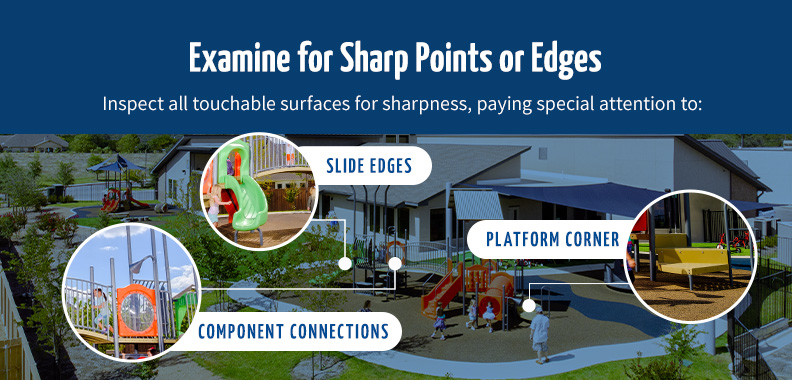
Exposed metal edges, splintered wood, or cracked plastic may create contact hazards. Inspect all touchable surfaces for sharpness, paying special attention to slide edges, platform corners, and areas where components connect. Equipment deteriorates over time, so surfaces that passed inspection last year may develop rough edges this year. Teaching kids and supervisors basic playground safety rules can help reduce the chances of unsafe behavior.
6. Identify and Remove Tripping Hazards
Uneven surfacing, exposed concrete footings, tree roots, and debris may affect safe circulation, especially in high-traffic areas where kids play. Inspect pathways and play areas for levelness and remove any obstacles. Borders that contain loose-fill surfacing should sit flush with the surface level, not create a raised edge that could increase the chances of kids tripping. Anchor points for equipment should be buried or covered to help reduce the chance of toe-catches.
7. Verify Guardrails Are Secure and In Good Condition
Guardrails and protective barriers help reduce the chances of falls from elevated platforms. Check that rails are securely fastened, with no wobbling or looseness when pressure is applied. Height matters too. Guardrails on elevated platforms should meet height requirements established by CPSC safety standards to help reduce the chances of falls. Look for gaps in the barrier system that a kid could slip through, or damage that weakens the rail system’s structural integrity.
Key Playground Safety Certifications and Standards to Know
Understanding the safety standards and certifications that govern playground equipment helps you make informed decisions during inspections and equipment selection. These organizations establish the benchmarks that separate compliant, tested equipment from products that may not meet safety standards:
- Consumer Product Safety Commission (CPSC): The CPSC publishes the Public Playground Safety Handbook. Within, they provide voluntary guidelines covering equipment design, installation, surfacing, and maintenance for public playgrounds.
- American Society for Testing and Materials (ASTM) International: ASTM develops consensus standards for playground equipment and surfacing. Many jurisdictions adopt these guidelines as mandatory requirements since they cover everything from structural integrity to protective surfacing performance.
- Children’s Product Certificate (CPC): This certification demonstrates that playground equipment has been tested by an accredited laboratory and meets applicable CPSC and ASTM standards.
- Americans with Disabilities Act (ADA): ADA requirements address accessibility. It also sets standards for transfer systems, ramp slopes, ground-level play components, and accessible routes that allow kids with disabilities to access and enjoy play spaces.
- International Play Equipment Manufacturers Association (IPEMA) certification: IPEMA certification indicates that an independent lab has verified a product’s compliance with ASTM standards, providing third-party validation of safety claims.
- Certified Playground Safety Inspector (CPSI) certification: Offered by the NRPA, CPSI certification trains professionals to conduct thorough playground safety inspections and audits in accordance with recognized standards.
How Often Should You Inspect Your Playground?
A consistent inspection schedule makes it easier to identify maintenance needs early, supporting ongoing safety and cost-effective upkeep. These varied frequencies create a layered safety net that addresses immediate hazards and ongoing equipment maintenance needs.
Daily and Weekly Visual Checks
High-use playgrounds benefit from daily visual sweeps to identify obvious hazards such as broken glass, vandalism, or displaced surfacing. These quick checks take only minutes but help catch any immediate issues. Weekly inspections can be slightly more thorough, examining high-wear components like swing chains, slide exits, and frequently touched surfaces for emerging issues.
Monthly Maintenance Inspections
A monthly playground safety inspection involves hands-on testing of moving parts, connections, and structural elements. Check that all hardware remains tight, moving components operate smoothly without binding or unusual noise, and surfacing maintains adequate depth. Document any wear patterns that suggest components may need to be replaced soon.
Annual Certified Audits
An annual comprehensive audit conducted by a CPSI offers professional expertise and a detailed assessment. These certified professionals bring specialized training and measurement tools to assess compliance with current CPSC and ASTM standards. Annual audits create documentation that demonstrates due diligence in maintaining a safe play environment.
Creating an Inclusive and ADA-Compliant Playground
Playgrounds should welcome kids of varying abilities. ADA compliance is a legal requirement that sets accessibility standards for public playgrounds. Accessible playgrounds meet these standards by providing features such as transfer systems, accessible routes, and ground-level play components for kids with disabilities. Inclusive playgrounds go beyond ADA requirements. While they start with ADA compliance as the foundation, inclusive play spaces offer a broader variety of play experiences designed to bring kids of varying abilities together.
During playground equipment inspections, verify that accessible routes remain clear and properly maintained, ground-level play components function correctly, and transfer systems remain stable and usable. These ADA-compliant features form the baseline for accessibility.
For inclusive playgrounds, also check that varied play experiences continue to function as designed, sensory elements remain in good condition, and equipment placement continues to support play opportunities for kids of varying abilities.
Regular inspection of accessible playground features helps you confirm that these elements remain in good working condition, supporting your commitment to welcoming play environments.
Upgrade to Compliant Equipment With Little Tikes Commercial
When inspections reveal worn-out, noncompliant, or outdated equipment, Little Tikes Commercial is ready to assist. With decades of experience partnering with facility managers, park directors, and school administrators, Little Tikes Commercial designs and installs playgrounds that help you meet or exceed safety standards.
A commitment to safety is built into the design process and backed by industry-leading warranties that help you preserve your playground so it can be enjoyed for years to come.
Request a quote today to get started.