
A Guide to Daycare Playground Funding
Playgrounds are where imaginations run wild, children make friends, and the benefits of outdoor play become tangible. But when you start pricing out playground projects, it won’t take long for the numbers to climb well beyond what your budget can comfortably handle.
The secret is that many playgrounds become reality due to a combination of sources, including daycare playground grants, nonprofit programs, and community fundraising. This guide breaks down what’s available, spotlights funding programs in Georgia, South Carolina, and North Carolina built for early childhood programs, and explains what qualities make grant applications stand out.
Funding for Daycare Playgrounds
The most successful daycare playground projects raise money from multiple sources. Combining funding streams is a strategic way to meet your total budget without stretching any single source too thin.
Government Grants
Federal and state government programs are among the most reliable sources of grants for daycare playgrounds, particularly for licensed facilities serving low- to moderate-income families. One of the broadest federal options is the Community Development Block Grant program, which funds community facilities, including playgrounds and childcare centers. CDBG dollars flow through local city and county governments, so reach out to your local government office to ask about eligibility and current funding cycles.
State agencies also run targeted grants for licensed daycare playground facilities. These state-level options — covered in the next section — tend to have more accessible application processes designed with early childhood providers in mind. Most government grants require your facility to serve low-to-moderate income families, hold an active childcare license, and maintain good standing with your state’s licensing agency.
Nonprofit and Corporate Grants
National nonprofit organizations and corporate foundations offer another major funding stream, and several programs focus specifically on playground access and early childhood development. KaBOOM! is one of the most active players in this space. Since 1996, they’ve helped build or improve more than 17,000 playgrounds across the country. Their community-built playground grants are available in cities including Atlanta, Charlotte, and Wilmington, and prioritize applicants serving low-income or special-needs communities.
In 2025, KaBOOM! launched the Georgia Playspace Refresh Fund, awarding grants of up to $25,000 to child-serving nonprofits and municipal agencies across Georgia to renovate existing playgrounds. Corporate grant programs also support playground projects — the Lowe’s Charitable Foundation’s Toolbox for Education program and the Walmart Foundation offer community grants that childcare centers serving low-income populations may qualify for. If your daycare is a Head Start affiliate, check with the National Head Start Association for funding opportunities.
Community Fundraising and Crowdfunding
Raising money for a daycare playground through community-led efforts creates momentum, strengthens relationships with families, and signals to grant reviewers that people want to see the project succeed. Walk-a-thons, bake sales, local business sponsorships, and donation drives contribute to your total while deepening your support network.
Crowdfunding your playground project extends your reach beyond the families you serve. Online platforms let you share your vision widely, and campaigns tied to a specific, visible goal tend to perform best. Many grant programs require applicants to demonstrate that a portion of the project is community-funded, so your fundraising work serves as proof of local support.
From bake sales to matching donation drives, the most successful playground projects blend multiple funding streams. Building that combination early gives your project the best foundation.
State Funding Programs for Daycare Playgrounds
State-level programs are often the strongest starting point for funding for daycare playgrounds. Purpose-built for early childhood providers, these programs tend to have more accessible application processes than federal grants — and they exist across the country, meaning there’s likely something available regardless of your location.
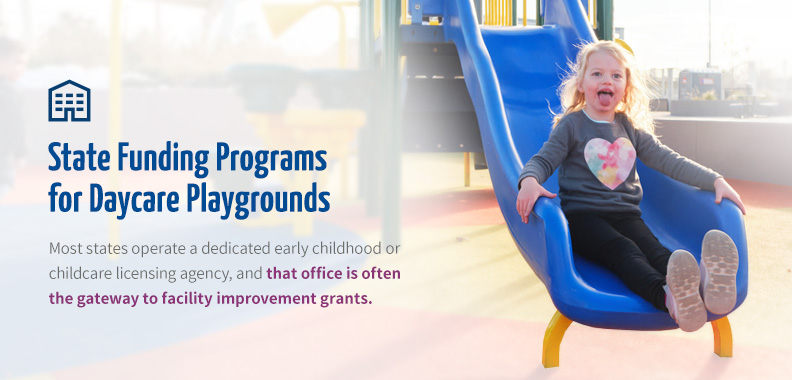
Most states operate a dedicated early childhood or childcare licensing agency, and that office is often the gateway to facility improvement grants. Reaching out to your state’s childcare licensing agency is one of the most reliable starting points when researching grants for daycare playground projects.
1. State Childcare Licensing Agencies
The agency responsible for your operating license is often the same one that administers facility improvement grants for licensed childcare providers. These programs cover playground equipment, outdoor learning environments, surfacing, and safety upgrades. Award amounts, eligibility requirements, and application windows vary by state and funding cycle, so check your agency’s provider resources page regularly or sign up for their updates to stay in the loop.
When you reach out, ask specifically about health and safety grants, facility improvement programs, and outdoor play space upgrades. Coming in with specific questions helps you move quickly when a funding cycle opens.
2. Quality Rating and Improvement System Grants
Many states administer grants through their Quality Rating and Improvement System. By design, this program helps licensed childcare providers improve program quality and advance their state’s quality rating. Facility improvements, including playground upgrades and outdoor learning environments, frequently qualify for QRIS-related funding.
If your state has a QRIS program, check with your childcare licensing agency or local CCR&R agency to learn whether playground projects are eligible and what the application process looks like.
3. CCDF Quality Set-Aside Programs
The Child Care and Development Fund is a federal block grant distributed through every state. States must set aside a portion of CCDF dollars for quality improvement activities, and many channel those funds toward grants for licensed childcare providers — including projects that improve outdoor play spaces.
Your state’s childcare licensing agency or CCR&R can tell you whether your facility is eligible for a portion of the CCDF quality funds distributed in your area. When raising money for a daycare playground, CCDF-funded programs are worth exploring as a consistent source of support for licensed providers nationwide.
Tips for Applying for Daycare Playground Grants
Grant writing is a skill you can perfect with time. If you are a novice, know that every application teaches you something — and that most playground projects require multiple attempts to secure the perfect combination of funding. These four strategies will strengthen your approach.
- Start local, then expand: Local and county grants have smaller applicant pools and higher approval odds. Exhaust those options first, then move to state programs, and finally, national grants.
- Apply to multiple grants simultaneously: Most grants for daycare playground projects won’t cover your entire budget, so applying broadly improves your odds of raising the full amount. Several smaller awards can add up to one complete project.
- Keep core documents ready: Grant cycles often have tight deadlines. Having your childcare license, photos of your current play space, and a basic budget estimate on hand means you can move quickly when application windows open.
- Be specific about need: Vague applications get rejected. Concrete details — number of children served, current condition of equipment, specific improvements planned — make your case compelling.
What to Include in a Daycare Playground Grant Application
Most daycare playground grants require similar core components. Individual programs will have specific requirements, but these elements appear across nearly every application.
- Project description: Outline what the playground project involves — new equipment, safer surfacing, shade structures, or safety improvements. Be specific about the direct benefit to the children you serve.
- Statement of need: Describe the current condition of your play space, estimate how many children will benefit, and identify the specific gap or safety concern the project addresses.
- Itemized budget estimate: Provide a line-by-line breakdown covering equipment, installation, surfacing, permits, and additional project costs.
- Proof of licensure and good standing: Include your current childcare license and documentation proving you’re in good standing with your state licensing agency.
- Photos of the current play space: Show condition, size, layout, and any visible safety concerns. Visual evidence strengthens your case.
- Project timeline: Offer realistic milestones from grant award through project completion.
- Vendor quotes or estimates: Demonstrate project readiness and show your cost figures are realistic.
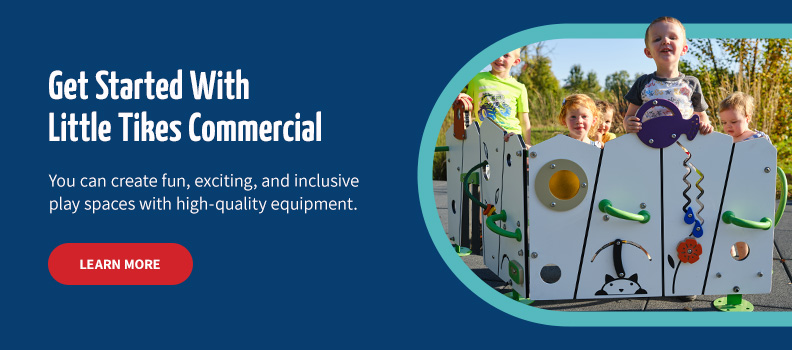
Get Started With Little Tikes Commercial
Little Tikes Commercial’s free funding guides walk you through grant strategies, fundraising ideas, and budgeting — all built with early childhood programs in mind. And when you’re ready to turn your funding plan into an actual playground, we’ll partner with you to bring your vision to life.
Your kids deserve a play space where imaginations take off and life skills grow naturally through outdoor play. You can create fun, exciting, and inclusive play spaces with high-quality equipment — built with materials engineered for years of community use and safety standards woven into every detail. Whether you’re still exploring daycare playground grants or thinking about diving into the grant guide and starting your application, you have what you need to build something kids will remember.