
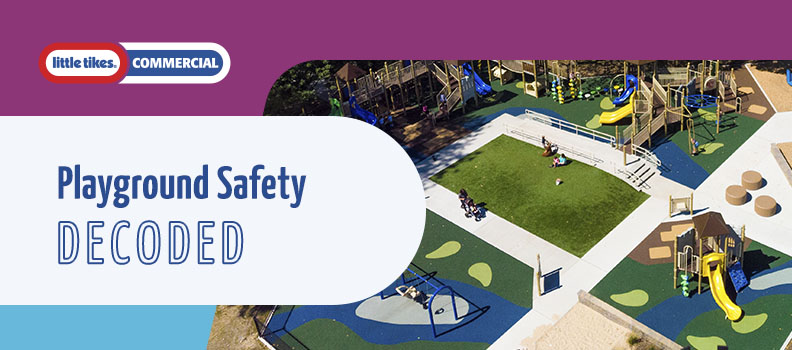
Playground Safety Decoded
Playground planning carries high stakes. Spaces must encourage kids to play, climb, hide and explore while mitigating potential injuries associated with falls and equipment use.
That balance becomes more challenging when you must wade through an alphabet soup of playground safety standards defined by organizations such as the U.S. Consumer Product Safety Commission (CPSC) and the American Society for Testing and Materials (ASTM) International.
Dense technical manuals can feel overwhelming, and uncertainty around compliance may create liability concerns. This guide explains how CPSC guidelines differ from ASTM standards and how each applies to playground equipment safety.
CPSC Guidelines and ASTM Standards
Playground safety relies on two widely used frameworks.
CPSC guidance focuses on injury prevention.
- Hazard identification: Guidance based on common playground injury patterns that shows where and how children are most likely to get hurt, helping owners address foreseeable hazards.
- Advisory guidance: Nonbinding recommendations — not law — that support planning, installation, inspection, and maintenance decisions for public playgrounds.
- Injury data insight: Safety advice informed by real-world injury data on falls, entrapment, impact, and other playground hazards.
- System-level oversight: Whole-playground considerations for layout, equipment arrangement, use areas, and surfacing so all elements work together.
ASTM standards set the technical design criteria for public playground equipment and surfacing.
- Performance standards: Detailed requirements that define how equipment and surfacing should perform when a product claims compliance.
- Compliance authority: Voluntary consensus standards that gain enforcement power when adopted into contracts, certification programs, inspections, or regulations.
- Measured performance: Quantified thresholds and test methods — for example, impact attenuation and fall height — that allow for consistent testing and manufacturer comparison.
Playground Safety Standards at a Glance
Playground safety guidance comes from a small set of foundational documents that work together.
- CPSC Publication 325: The Public Playground Safety Handbook offers nonbinding guidance on equipment design, layout, and common injury risks for public playgrounds.
- ASTM F1487: Establishes safety performance requirements for public playground equipment intended for children ages 2 through 12.
- ASTM F2373: Covers public-use play equipment designed specifically for children ages 6 to 23 months.
- ASTM F1292: Defines test methods for impact attenuation of protective playground surfacing materials within playground use sections.
- ASTM F2075: Sets material and performance requirements for engineered wood fiber (EWF) used in playground surfacing applications.
- ASTM F2479: Guidance for specification, installation, and maintenance of poured-in-place (PIP) playground surfacing.
- ASTM F1951: Addresses accessibility performance of ground systems under and around the playground equipment.
- ASTM F3012: Establishes requirements for loose-fill rubber used as protective ground material.
High-Priority Areas for Playground Equipment Safety
Play-related injuries often result from falls, unintended contact with other children, and entanglement hazards. Focusing on these areas ensures playground equipment safety. The guidance follows CPSC Publication 325 and ASTM F1292 and F1951 for surfacing and accessibility.
Effective oversight depends on surfacing performance, spacing discipline, opening design, and age-appropriate separation. Address the following areas that warrant closer attention during review and maintenance.
- Surfacing compliance: Align impact-attenuation performance with tested fall-height ratings using manufacturer data rather than material depth alone. Confirm systems meet applicable surfacing specifications in line with ASTM F1292. Engineered wood fiber and poured-in-place rubber require proper specification, installation, and ongoing maintenance.
- Use areas and spacing: Follow CPSC and ASTM guidance — especially ASTM F1487 use‑area criteria — to ensure each piece of equipment has the proper clearance around it. Some structures need larger or uniquely shaped use zones, so adjust spacing as needed. Keep high‑motion activities separated, and avoid placing swings or slide exits where they overlap with other play areas.
- Entrapment and projections: Evaluate openings using established test methods referenced by CPSC and ASTM criteria, such as ASTM F1487. Inspect hardware components for projections that can catch clothing or drawstrings. Address issues promptly.
- Age separation: Age-based separation reduces injuries linked to differences in size, coordination, and play behavior. Use signage and physical barriers to distinguish areas intended for ages 2 to 5, consistent with CPSC 325 and ASTM F1487 age-group guidance.
Design for Compliance With a Pre-Installation Protocol
Playground safety standards start well before equipment arrives on-site. Early planning choices can either support long-term compliance or introduce risks that are challenging to correct after installation.
Site and Environment Assessment
Site conditions shape how a play area performs once it’s in use. Proactively review environmental factors to reduce playground safety risks before they become impossible to mitigate later.
- Slope and grading: Uneven terrain can affect equipment stability and the risk of falls.
- Drainage patterns: Poor drainage may lead to standing water and long-term material degradation.
- Sun exposure: Prolonged heat can raise temperatures on play components and walking areas, increasing the risk of burns.
- Surrounding features: Fences, walls, or hardscape may restrict required clearances.
Accessibility and Inclusive Design
Playground safety includes access for children and caregivers with mobility needs. Accessible design supports inclusive play while reducing secondary hazards caused by uneven or restrictive layouts.
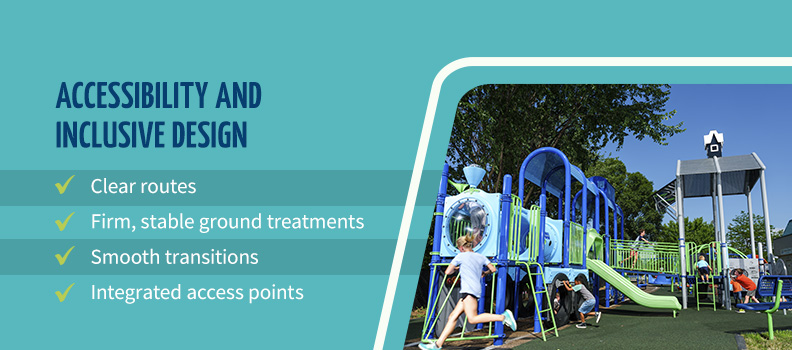
- Clear routes: Pathways should be wide enough to accommodate mobility devices.
- Firm, stable ground treatments: Surfaces should support wheels and walking aids.
- Smooth transitions: Elevation changes should be mild to limit tipping or abrupt movement.
- Integrated access points: Build inclusive features into the layout instead of adding them on.
Certified Design and Installation
Even compliant equipment can become misaligned if installed incorrectly. Qualified installation lets the finished layout better reflect the manufacturer’s tested design and safety intent.
- Qualified installers: Professionals trained in current play area safety guidance.
- Accurate assembly: Equipment installed to specified heights, clearances, and layouts.
- Proper anchoring: Secure installation that prevents movement affecting spacing or openings.
- Clear documentation: Records that support inspections, maintenance, and compliance reviews.
The Proactive Checklist for Playground Safety
A proactive approach relies on consistent inspection and timely correction rather than reactive repairs. Use a structured playground safety checklist to match inspection tasks to risk and frequency. Consistently document your findings to ensure they remain current and actionable.
Prioritize the following inspection checks.
- Frequency: Separate low-frequency checks, such as seasonal structural reviews, from tasks you must finish more often, such as vandalism checks or inspections after bad weather.
- Hardware and integrity: Inspect for loose bolts, rusted metal components, cracked plastic elements, and missing protective caps.
- Surfacing levels: Monitor kick-out areas beneath swings and slide exits where displacement occurs. Rake and replenish loose-fill surfacing to maintain the required depth.
- General hazards: Scan for broken glass, user modifications such as ropes tied to equipment, and signs of insect infestation.
Putting Playground Safety Guidance Into Context
Playground safety functions as a continuous process that extends from early planning through installation, inspection, and ongoing care rather than a single checkpoint. A clear understanding of how CPSC and ASTM International standards interact helps teams interpret documents, evaluate design decisions, and plan maintenance activities over time.
As standards evolve through technical review and industry collaboration, experience becomes valuable when navigating them. Little Tikes Commercial is compliant with applicable ASTM standards and holds ISO 14001:2015 certification at our Monett, Missouri, manufacturing facilities, supporting consistency across design and production.
Request a quote today, and let’s discuss how standards-informed playground equipment can benefit your project.