
Best Playground Equipment for Early Childhood
Installing quality playground equipment is one of the most visible investments in children’s growth and development. The right setup can transform outdoor time into a launch pad for motor skills, social connection, imagination, and resilience. This guide delivers a clear breakdown of the best commercial playground equipment for early childhood settings — specifically daycares and preschools — so you can make confident decisions that align with students’ needs.
After you’ve identified the best equipment for your students, consider inclusivity and safety. Playgrounds should accommodate every student and offer peace of mind for adults, knowing equipment adheres to safety standards. A professional team can help you make the best decisions for your center by offering inclusive design, customization options, and equipment that meets safety guidelines.
Best Early Childhood Playground Equipment at a Glance
Different age groups need different equipment to support their developmental stage. Here’s a quick comparison of early childhood playground equipment for daycares and preschools:
| Daycare Centers | Preschools | |
|---|---|---|
| Age | 0-3 years | Typically 3-5 years |
| Playground Equipment |
|
|
Daycares
Daycares often serve the youngest children, with a mix of developmental stages under one roof. This age group thrives when environments prioritize safety, sensory stimulation, and emerging motor skills, so the best playgrounds for daycares create spaces where toddlers can explore confidently.
Top Playground Equipment for Daycare Settings
Here are the best options for daycares:
- Low-rise climbing structures: Young ones at this age love testing their physical limits, and low-rise structures offer a safe way to experience a sense of accomplishment. These structures can support gross motor skills, balance, coordination, and strength.
- Playhouses: Imagination can flourish without limits in a playhouse, making it the perfect setting for enacting various roles and stories. Through cooperative play, role-playing, and storytelling, playhouses can help boost social-emotional development.
- Toddler swing sets: The rhythmic motion can be both calming and exciting, giving kids a sense of floating or flying. Vestibular stimulation from swinging can support sensory integration, which may help children organize sensory information and develop a better sense of their bodies in space.
- Spring riders: These come in many shapes and forms to spark the imagination, and toddlers enjoy the wobbly, bouncy sensation spring riders offer. Children use their bodies to create motion, which can support balance, core strength, and coordination.
- Activity panels: Kids love the interactive nature of activity panels — they can manipulate gears, trace mazes, spin elements, or discover different textures and sounds. These engaging activities can support the development of fine motor skills, hand-eye coordination, and cognitive abilities such as problem-solving and cause-and-effect reasoning.
Why Outdoor Play Matters for Daycare-Age Children
Outdoor play offers a wealth of benefits that extend far beyond physical exercise. The early care and education guidance notes of the Centers for Disease Control and Prevention (CDC) state that outdoor play helps children develop strong bodies, meet developmental milestones for movement, and improve attention spans. Rather than “free time,” outdoor play serves as a vital component of a young child’s learning and growth.
Preschools
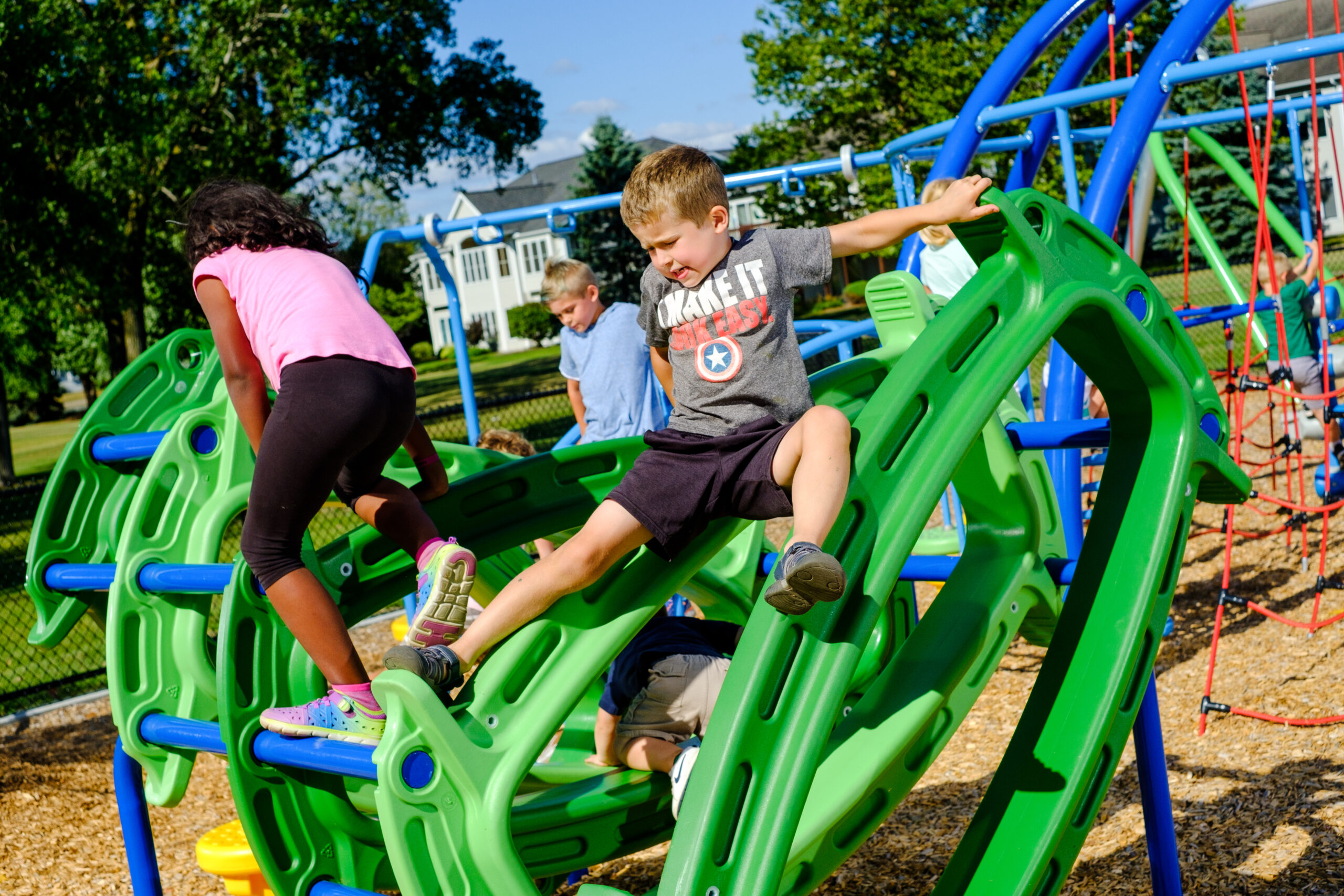
Active, imaginative preschoolers develop social skills rapidly, requiring equipment that supports greater physical challenges and cooperative play. The best playgrounds for three- to five-year-olds offer a balance of physical activity, imaginative themes, and learning opportunities.
Best Playgrounds for Preschools
Children love the following equipment:
- Themed climbing structures: These structures transform a playground into a fantastical world where children can pretend to be pirates, knights, or astronauts. Creativity and social development can flourish as kids engage in cooperative role-playing and storytelling.
- Slides: Preschoolers love the anticipation of the climb, the rush of the ride down, and the feeling of momentum. Climbing can build gross motor skills, balance, and coordination, while taking turns can introduce early concepts of social rules and patience.
- Nature-inspired play systems: Unique textures, irregular shapes, and open-ended play opportunities stimulate curiosity. Nature-inspired play structures encourage a connection with nature. These systems might also offer nonlinear climbing paths and allow children to adapt to uneven surfaces, challenging gross motor skills, balance, and agility.
- Playground learning walls: Learning walls provide engaging activities that blend play with discovery. Kids can move parts, create sounds, or solve simple puzzles. Manipulating components can help build fine motor skills and hand-eye coordination. Additionally, learning walls can introduce preschoolers to numbers, letters, and shapes.
Why Outdoor Play Matters for Preschool-Age Children
Research and early childhood education organizations recognize outdoor play as essential for preschool development. The National Association for the Education of Young Children (NAEYC) supports play-based learning as the core mechanism through which preschoolers develop curiosity, initiative, problem-solving, and focused attention.
When you tailor a playground to meet local needs and make activities fun and interesting, children become more enticed to play. Studies show that kindergartens that upgrade their play structures can boost a child’s physical activity, supporting learning through play.
The Value of Working With a Professional Playground Team
Designing the best playgrounds for preschools and daycares requires more than selecting equipment from a catalog. An expert team brings deep knowledge in child development, safety standards, and creative design to offer thoughtful equipment that serves a purpose.
Create Inclusive Playgrounds
Experts go beyond basic Americans with Disabilities Act (ADA) compliance, which mostly focuses on access. Specialized designers cultivate meaningful play for children, regardless of age or skill level.
- Encourages social inclusion: Play spaces become meeting places where friendships develop naturally.
- Gives children independence: Kids freely enjoy the play space with adult oversight.
- Is imaginative: Creative playgrounds stimulate imagination, allowing children to engage in pretend play and build their own magical worlds.
- Provides active motion: Kids can spin, swing, and rock to their heart’s content.
- Is fun: Intentional design incorporates various play elements for a thrilling space.
- Offers graduated complexity: Children learn new skills at a pace they’re comfortable with, so every child is appropriately challenged.
Test for Safety
Equipment must meet safety guidelines and standards. Every piece of equipment you install should meet or exceed ASTM International standards, and it’s best if pieces also adhere to Consumer Product Safety Commission (CPSC) guidelines. Check that manufacturers have tested equipment and that it complies with ASTM F1487 standards. This standard aims to mitigate common hazards, including falls, head entrapment, protrusions, pinch points, and structural failures.
Cares About Child Development
Playground designers usually have deep knowledge of child psychology, early childhood education, and developmental milestones. They can select the right equipment for specific age groups — equipment that allows children to push their boundaries and develop resilience while following safety guidelines.
Offer Customization
While off-the-shelf solutions exist, an expert team can tailor a playground to the unique needs, space, and budget of a daycare or preschool. Teams can offer site-specific solutions to build an optimized design. They can also incorporate specific themes or develop a design that aligns with the center’s aesthetic. With the right team, you can build the dream playground young kids love.
Design Your Early Childhood Playground With Little Tikes Commercial

You now have a clearer picture of what a purposeful play space can be — one that sparks wonder and helps build life skills. Little Tikes Commercial empowers kids to flourish and have fun.
Whether you’re outfitting a space for children six to 23 months or looking for the best playgrounds for two- to five-year-olds, the right equipment makes all the difference. Request a quote or get in touch with Little Tikes Commercial to start designing the playground your young students will love.