
Best Playground Equipment for Schools
Selecting playground equipment for a school goes beyond choosing what looks appealing. Every age bracket has distinct physical, social, and cognitive skills, and equipment that challenges an eighth-grader’s strength serves a very different purpose than themed playsets for second-graders.
Elementary and middle school students benefit from a range of equipment that matches their developmental stages. School administrators, principals, and landscape architects need to select the best school playground equipment to meet students’ needs while balancing budget constraints, safety compliance, and inclusive design. By considering these factors, you can install a playground that offers enjoyment and skill-building.
Elementary vs. Middle School Equipment
| Elementary School | Middle School | |
| Age Range | 5 to 11 | 11 to 14 |
| Recommended Equipment Types |
|
|
Elementary Schools
Elementary-age children are at a prime stage to master gross motor skills, develop social skills, and foster their imaginations. Play structures with multiple components support varied physical and cognitive engagement, giving students opportunities to climb, slide, swing, and create narratives together.
The Best Playground Equipment for Elementary Schools
The most popular equipment for elementary school students includes the following.
- Slides: The thrill of speed and the sensation of gliding down a smooth surface keep kids coming back. Climbing to the top of a slide can improve gross motor skills and coordination, building confidence with each successful ascent.
- Climbing equipment: These structures appeal to a child’s instinct to explore and can strengthen problem-solving as students figure out the best routes. This type of school playground equipment can also enhance upper-body strength and coordination.
- Swing sets: Young learners love the sensation of soaring and weightlessness. Swinging can build balance and coordination as children learn to pump their legs to go higher.
- Themed playsets: Castles, pirate ships, or rockets ignite imaginations and offer a backdrop for passionate pretend play. These playsets can foster creativity, imagination, and emotional growth through role-playing and communication.
- Spinners and motion play: Merry-go-rounds, and other spinning or rocking elements deliver novel sensations of movement and speed. These are fantastic for strengthening vestibular processing, which helps with balance and spatial orientation. These elements also encourage social interaction and cooperation as kids push each other or spin together.
The Importance of Playgrounds for This Age Group
The American Academy of Pediatrics affirms that recess is crucial for K-12 students, citing social skills development and healthier bodies as key benefits. Playgrounds are dynamic social learning environments that are fundamental to a child’s holistic growth throughout elementary school.
Incorporating various play equipment transforms outdoor spaces into environments where students can advance socially and physically. An NIH-funded observational study found that innovative playgrounds generated nearly three times more moderate-to-vigorous physical activity than traditional post-and-platform playgrounds. The best playgrounds for elementary school combine varied surfaces, open-ended structures, and movable equipment to maximize engagement.
Middle School Playgrounds
Middle school students need equipment that reflects their growing strength and cognitive capabilities. Equipment that features varied upper-body tests and promotes social engagement helps this age group stay active while meeting their developmental needs.
The Best Playground Equipment for Middle School
Middle schoolers enjoy the following equipment.
- Challenge climbers: More complex than typical climbing structures, these offer physical and mental challenges that may include rope courses, nets, or structures that require greater strength and agility. They build strength while enhancing problem-solving, strategic thinking, and risk assessment.
- Bouldering walls: Emphasizing strength, technique, and problem-solving, these structures can improve body awareness, flexibility, and coordination. Figuring out routes can also boost cognitive skills, planning, and mental focus.
- Social gathering elements: Seating areas, hammocks, and discussion circles create a place for students to relax, observe, and connect with friends. These spaces can support social and emotional growth by facilitating peer bonding and communication.
Fitness Equipment
Apart from play equipment, tweens and teens can benefit from outdoor fitness stations where they can track their physical progress and engage in friendly competition. Incorporating this equipment into a playground can encourage a lifelong interest in fitness and deliver a tangible sense of accomplishment.
The Importance of Playgrounds for This Age Group
Physical activity can decline sharply during a student’s tween and early teen years. School playgrounds are among the few environments that counteract this drop, creating opportunities for movement that might not otherwise happen.
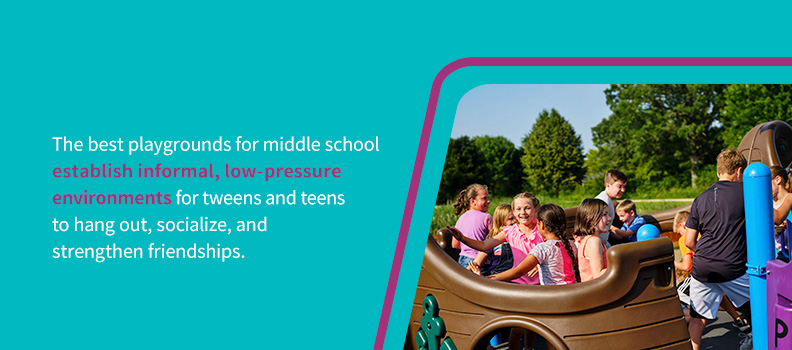
During middle school, peer relationships take center stage. The best playgrounds for middle school establish informal, low-pressure environments for tweens and teens to hang out, socialize, and strengthen friendships. Additionally, adolescence can be a time of increased stress due to academic pressure, social dynamics, and hormonal changes. Time spent outside offers a valuable outlet for burning off energy, reducing stress, and improving mood.
Factors to Consider When Choosing Equipment
After selecting the ideal equipment for your school’s age group, you must to consider student safety and the ability to create a comprehensive, inclusive play area. If budgetary constraints are an issue, look for proactive strategies to create unforgettable experiences while saving money.
Safety
Quality equipment meets established safety guidelines set by organizations such as ASTM International and the Consumer Product Safety Commission. When selecting pieces, look for certification from the International Play Equipment Manufacturers Association, a third-party organization that verifies whether equipment meets ASTM standards. Through independent testing, IPEMA reviews a wide range of safety aspects, including structural integrity, entrapment hazards, sharp edges, and fall areas.
Inclusivity
Children of varying abilities can play together on an inclusive playground, fostering connection and promoting understanding.
Every playground should meet or exceed Americans with Disabilities Act requirements, which often focus on physical accessibility. However, do your best to offer a play area that provides multiple opportunities.
- Unleash playful narratives: By designing a play space around a theme, you can encourage pretend play and help kids strengthen creative, cognitive, and social skills.
- Foster connection: Design a space that encourages social inclusion, allowing friendships to blossom among students of different abilities.
- Cultivate confident play: Give children of different abilities the freedom to use play areas with appropriate oversight, improving their confidence and self-reliance.
- Energize with engaging motion: Children can spin, swing, and rock to their delight, experiencing joy through movement.
- Offer adaptable levels of engagement: A playground that lets children refine new skills at their preferred pace builds confidence.
- Create excitement: Children learn by playing, so try to provide chances for them to grow.
Budget
Your budget impacts every playground design decision, from the variety of play areas to the quality of school playground equipment. Generally, costs include site preparation, surfacing, equipment, shipping, installation, and more — each of which requires careful planning.
Consider a phased approach that accounts for budgetary constraints. You can build your playground in sections as your finances permit, rather than funding the full project up front. Additionally, identify potential funding streams such as school funds, community grants, fundraising initiatives, and public budgets to supplement your resources.
Create a Wonderful Playground With Little Tikes Commercial
Choosing the right playground equipment means balancing student needs, safety standards, and budget realities. Little Tikes Commercial brings decades of experience designing play spaces that spark imagination, support growth, and welcome children of varying abilities. Whether you need a custom design tailored to your school’s unique space or a prebuilt solution, we’ll work with you from concept to installation.
We offer playground equipment for students aged 5 to 12 and options for older children that meet ASTM standards. You can request a quote or contact Little Tikes Commercial to start creating a play space that fits your vision.